Dispatches for the curious. Stuff that's neat.
Section: Dinosaurs
Friday, October 23, 2026

Infernogallus, a parrot-jawed Hell Creek dinosaur that may have eaten fruit

Posted by Captain Queso on Friday October 23, 2026 @2:49AM in Dinosaurs
from the five-a-day-in-the-cretaceous dept.
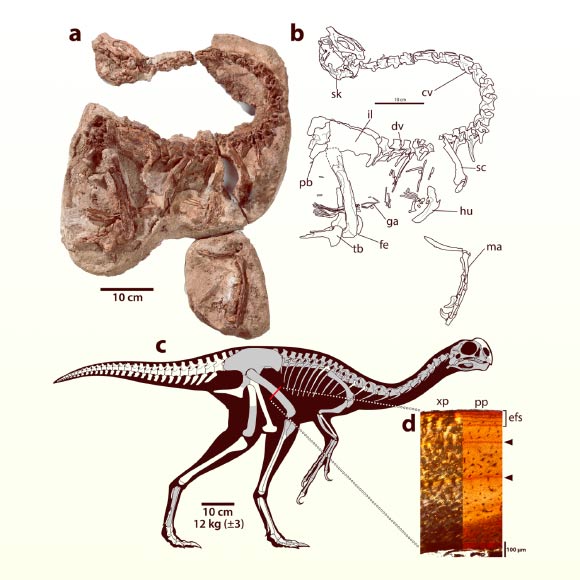
Hell Creek is T. rex country, so it is a nice change to meet a 12 kg neighbour with a weak bite and a sliding jaw that probably preferred fruit. The comparison to a living parrot is the bit that makes it click. Also a reminder that a nearly complete skull can sit in a collection for over a decade before its story gets told.

Researchers describe Infernogallus jamesi, a toothless oviraptorosaur from the very end of the Cretaceous in Montana and the Dakotas, from a near-complete skull collected in 2011. CT reconstructions of its jaw muscles point to a gentle, slicing bite, and with no gizzard stones found, the team argues for a soft, fruit-heavy diet. The paper is in Nature Communications.

Tooth marks suggest small raptors scavenged a dead young tyrannosaur

Posted by Captain Queso on Friday October 23, 2026 @1:49AM in Dinosaurs
from the leftovers-again dept.

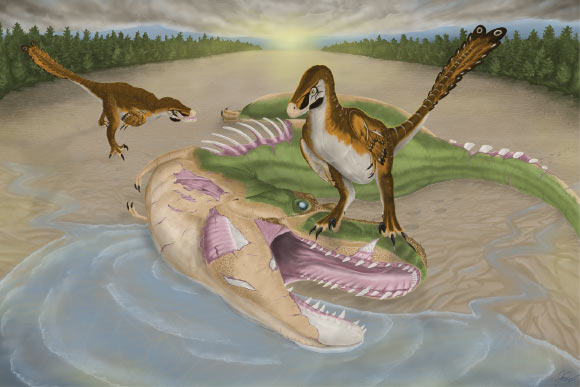
Forensic palaeontology at its finest: researchers measured serration spacing in bite marks, corrected for the angle of the bite, and named a likely suspect. The size gap makes the case, since a turkey-sized raptor was not taking down a half-tonne tyrannosaur, but it would happily clean up after one.

A jaw from a young Albertosaurus, about 70 million years old from Alberta, carries scrape marks matching the teeth of the dromaeosaur Atrociraptor. At an estimated 16 to 18 kilograms against roughly 530, the biter was probably feeding on a carcass rather than hunting. The study appeared in the Journal of Paleontology this month.

One small vertebra may be the oldest dinosaur from Iberia

Posted by Captain Queso on Friday October 23, 2026 @1:48AM in Dinosaurs
from the back-bone-of-the-algarve dept.

Not every dinosaur find is a skeleton; sometimes it is one 37 mm bone that moves a timeline by tens of millions of years. Worth noticing how much careful phylogenetic work can hang on a single centrum, and how honest the authors are about not naming it.

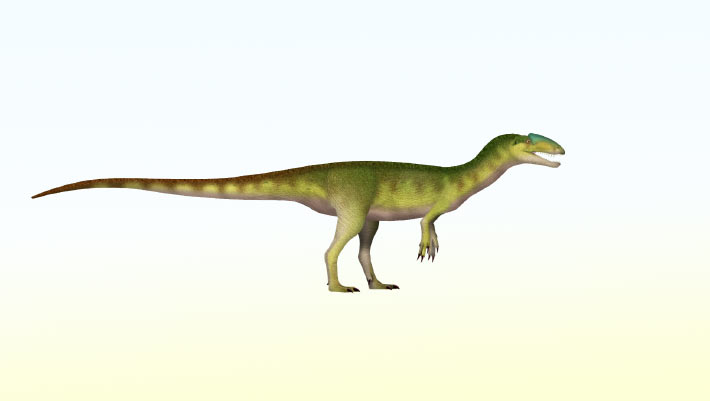
A vertebra from Late Triassic rocks near Loulé in southern Portugal, over 220 million years old, is the first Triassic dinosaur material from the Iberian Peninsula. Analysis places it among early neotheropods, closest to England's Sarcosaurus, but the bone is too incomplete to name a new species.

A megaraptor in a museum drawer: Britain's first long-clawed predator, a century late

Posted by Captain Queso on Friday October 23, 2026 @1:17AM in Dinosaurs
from the filed-under-misc dept.

Proof that the best fieldwork sometimes happens in a storeroom. A scrap of skull the museum bought in 1924 turns out to be the first megaraptoran ever found in Europe, which redraws the map for a whole family of big-clawed hunters. Bonus points for a name that translates as unconquered female warrior.

Researchers from UCL and the Natural History Museum have named Invictibellatrix amberina from a partial skull collected on the Isle of Wight by amateur collector Reginald Hooley. The animal lived about 120 million years ago and was roughly 3 to 4 metres long. The find suggests megaraptorans ranged widely early on, then faded out in the northern continents while their southern cousins became top predators.
Read the rest of this story (Natural History Museum)